Contemporary art has always enjoyed confusing people. Sometimes it is a banana taped to a wall. Sometimes it is an empty room filled with “ideas.” And sometimes, it is a Danish artist who receives a large amount of cash from a museum and simply decides not to give it back.
Meet Jens Haaning, a Danish contemporary artist known for exploring themes of power, economics, labor, and social inequality. Throughout his career, Haaning has often used unconventional methods to encourage people to think about how society works. However, in 2021, he created a work that made people wonder whether he was a genius, a comedian, or perhaps just very good at reading contracts.
The story began when the Kunsten Museum of Modern Art in Aalborg, Denmark, commissioned Haaning to recreate two earlier artworks. These works visualized average annual incomes in Denmark and Austria using actual banknotes attached to canvases. To produce the new versions, the museum lent him approximately 534,000 Danish kroner (around $84,000 at the time) in cash.
Everything seemed straightforward. The museum expected two framed artworks covered with money.
Instead, they received two completely blank canvases.
The title of the new artwork?
“Take the Money and Run.”
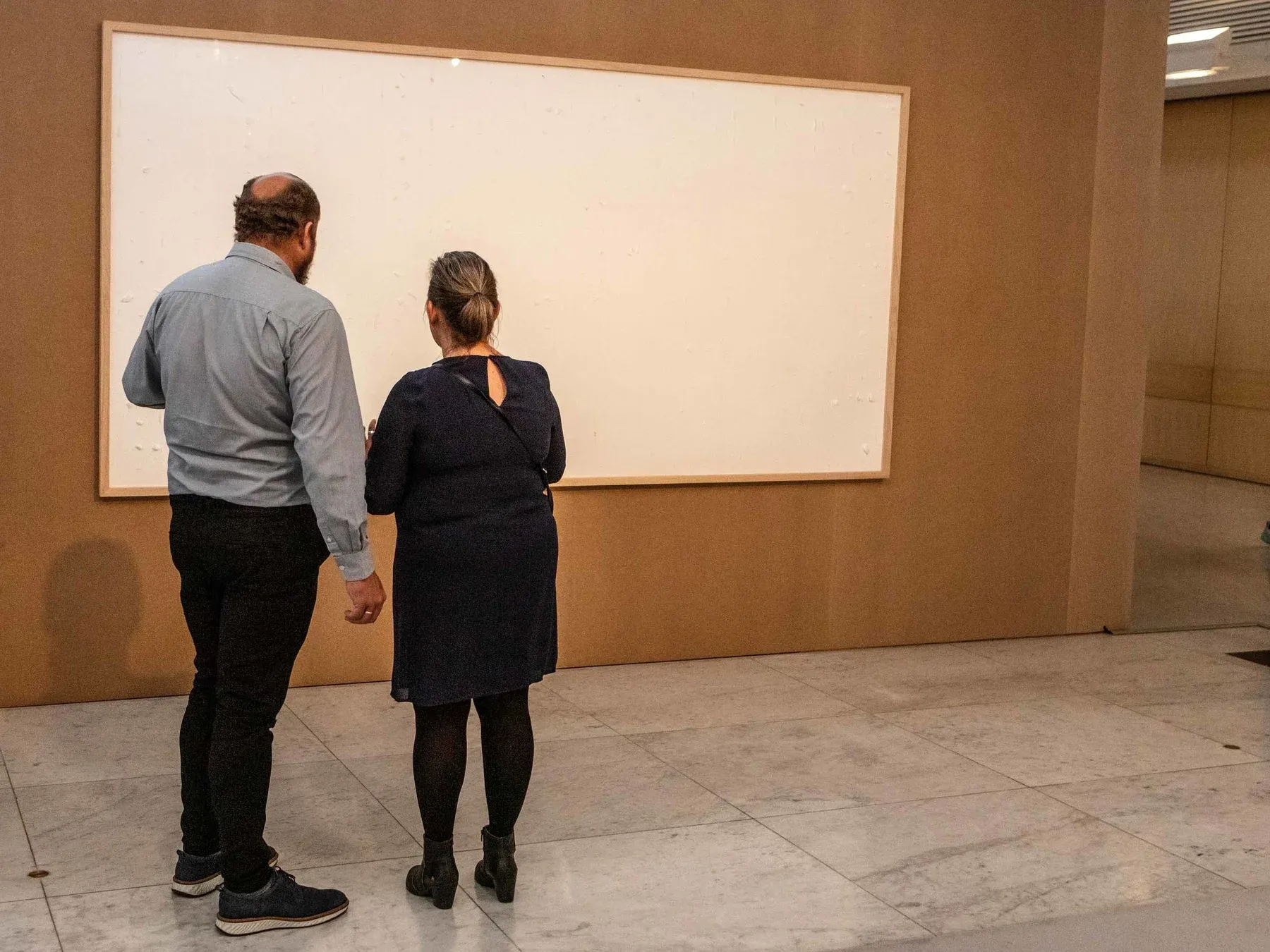 At this point, one can almost hear the museum staff staring silently at the empty canvases, checking their emails, checking the contract, and then checking their bank account.
But Haaning insisted that this was not theft—it was art.
 According to the artist, the work was a commentary on labor conditions and economic systems. He argued that reproducing the original pieces would have required significant work while offering inadequate compensation. By keeping the money and presenting empty canvases, he transformed the situation itself into the artwork. The missing money became the message.
Surprisingly, the museum decided to exhibit the pieces anyway. Visitors arrived to see two empty frames and a title that sounded less like contemporary art and more like advice from a very suspicious financial consultant.
The artwork quickly became an international sensation. News outlets around the world covered the story. Some praised Haaning for exposing contradictions within the art world. Others argued that the piece was simply an expensive joke. Many people, meanwhile, secretly wished they could submit a blank document at work and call it a conceptual masterpiece.
The controversy did not end with the exhibition. The museum later demanded that Haaning return the money. Legal disputes followed, and the case sparked debates about artistic freedom, contracts, value, and whether an empty canvas could really be worth hundreds of thousands of kroner.
Yet that question may be exactly what Haaning wanted people to ask.
What gives art its value? Is it the materials? The labor? The idea? The story? Or the fact that thousands of people are still talking about it years later?
Love it or hate it, “Take the Money and Run” succeeded in doing something many artworks never achieve: it made people pay attention. In a world overflowing with images, advertisements, and distractions, Haaning managed to turn a blank canvas into a global conversation.
And perhaps that is the ultimate irony.
The museum paid for artwork about money. The artist kept the money. The museum displayed the result. The public bought tickets to see it.
In the end, everyone got exactly what contemporary art often promises: more questions than answers.