These are not specimens in a natural history museum. They are artworks by British contemporary artist Damien Hirst, whose radical exploration of mortality has profoundly challenged the boundaries of modern artistic practice.
For Hirst, death is not simply a subject to be represented. It is a physical reality to be confronted, examined, and placed directly before the viewer.
The Illusion of Immortality
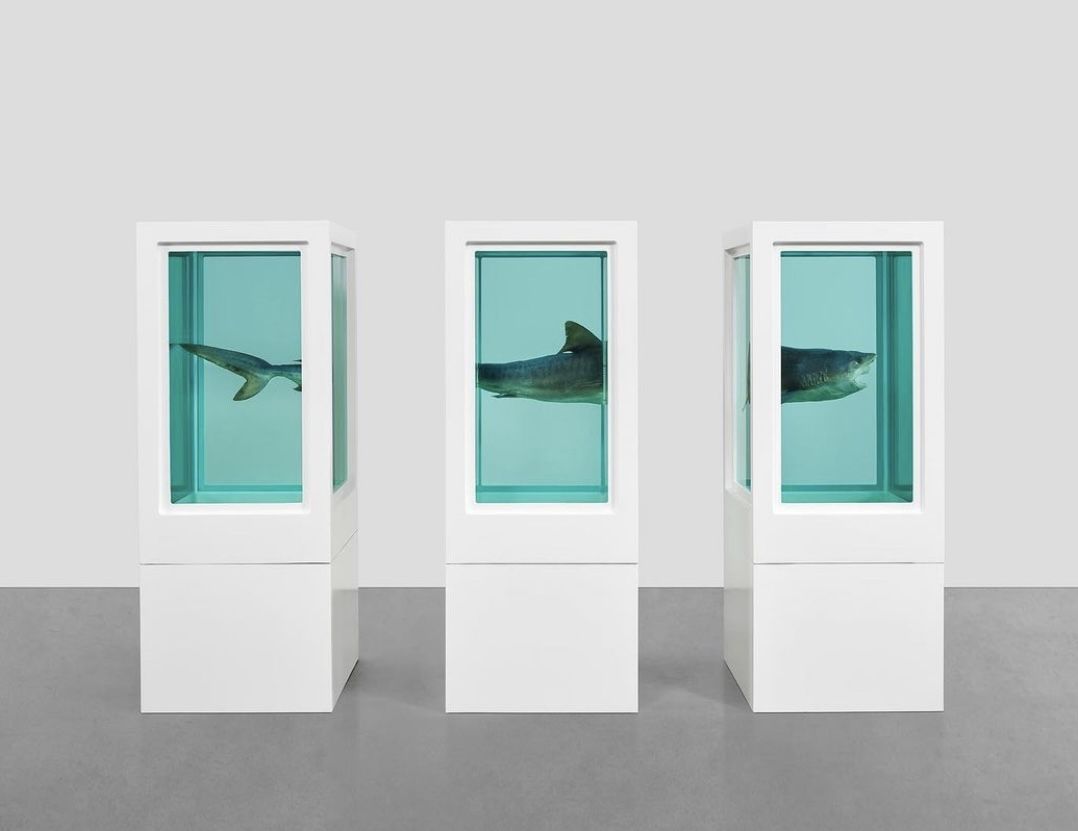
In 1991, Damien Hirst created one of the most recognisable artworks in contemporary art history: The Physical Impossibility of Death in the Mind of Someone Living.
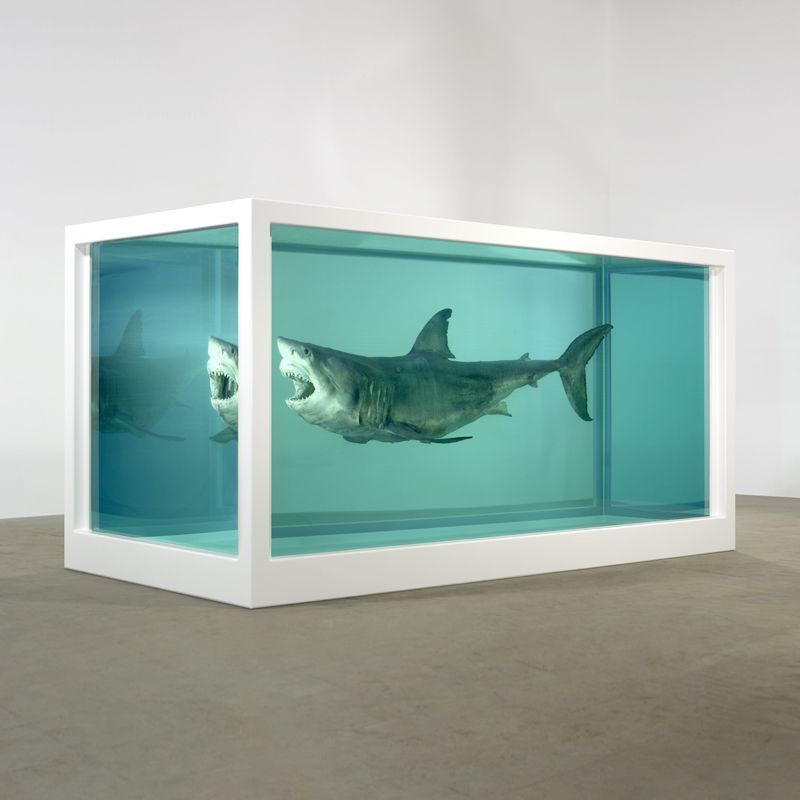
The work presents a tiger shark suspended in a large glass tank filled with formaldehyde solution. Its mouth remains open, its body seemingly poised in perpetual movement. Although the animal is dead, its physical presence retains an extraordinary sense of vitality.
The contradiction is immediate and disturbing. The shark appears almost alive, yet the transparent enclosure confirms its absolute separation from the living world.
By preserving the animal's body, Hirst creates an illusion of permanence. The biological process of decay is delayed, but death itself cannot be reversed. The work exposes a fundamental paradox of human existence: while we understand death intellectually, we remain unable to fully imagine our own nonexistence.
The glass tank becomes both a scientific container and a symbolic boundary, separating the living observer from the preserved body.
What appears to be an experiment in preservation ultimately becomes a meditation on the impossibility of escaping mortality.
The Fragility of Life
Hirst's examination of death becomes more emotionally complex in Mother and Child (Divided) (1993).
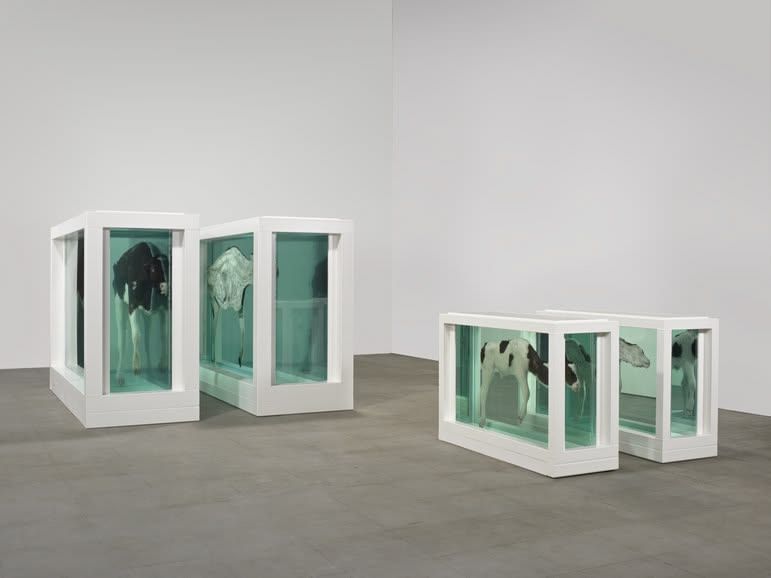
The installation consists of a cow and a calf, each divided lengthwise and displayed in separate glass tanks. Visitors can move between the sections, encountering the animals not as complete living beings, but as exposed anatomical structures.
The work transforms an intimate relationship between mother and offspring into a clinical experience of separation.
The cow and calf evoke familiar associations with nurture, protection, and biological continuity. Their physical division interrupts these associations, replacing the natural unity of life with the unsettling precision of scientific dissection.
The viewer is placed in an ambiguous position: simultaneously an observer, a participant, and a witness.
Through this encounter, Hirst questions whether scientific knowledge brings us closer to understanding life or merely reveals the limits of our emotional relationship with death.
The installation suggests that the body can be examined, categorised, and preserved, while the experience of being alive remains fundamentally beyond scientific measurement.
Between Innocence and Sacrifice
In Away from the Flock (1994), Hirst presents a solitary lamb suspended in formaldehyde.
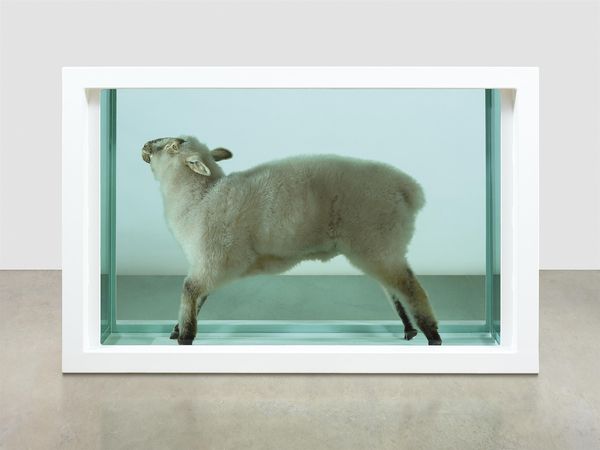 Unlike the threatening presence of the shark, the lamb evokes vulnerability, innocence, and quietness. Its delicate body appears almost weightless within the transparent enclosure.
The title suggests separation from a protective community, introducing themes of isolation and abandonment. At the same time, the lamb carries deep religious associations, particularly within Christian traditions, where it symbolises purity, sacrifice, and redemption.
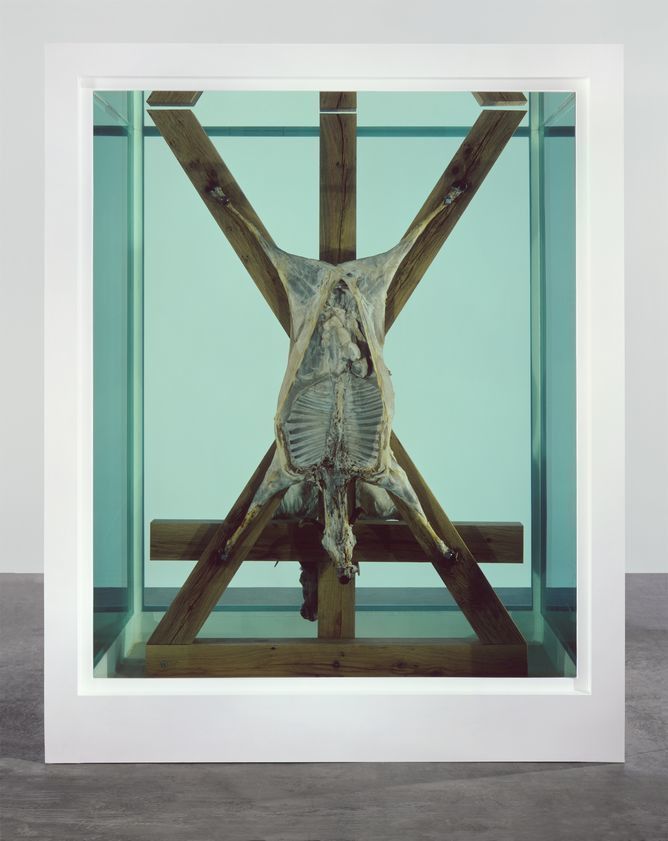
Hirst's use of religious imagery becomes more explicit in works such as God Alone Knows (2007), in which three flayed sheep are suspended in separate tanks, recalling the visual structure of the Crucifixion.
Here, the language of scientific preservation intersects with the history of religious representation.
The glass enclosure resembles a laboratory apparatus, while the suspended bodies suggest suffering, sacrifice, and the possibility of transcendence.
Rather than offering a clear distinction between science and faith, Hirst brings them into direct confrontation. Both may be understood as systems through which humanity attempts to explain mortality and confront the uncertainty of existence.
Yet neither can fully resolve the mystery of death.
The Laboratory as a Modern Temple
One of the most distinctive characteristics of Hirst's Natural History series is its visual language.
Glass, steel, formaldehyde, and clinical lighting create an atmosphere of scientific objectivity. The works resemble laboratory specimens or museum displays, carefully separated from the disorder of everyday life.
However, this apparent neutrality is deceptive.
The pristine surfaces and geometric containers intensify the emotional impact of the bodies they contain. The contrast between industrial precision and organic vulnerability produces a sense of both fascination and discomfort.
The glass tank functions as more than a display mechanism. It becomes a contemporary form of the reliquary: an object designed to preserve and elevate something that has been removed from ordinary existence.
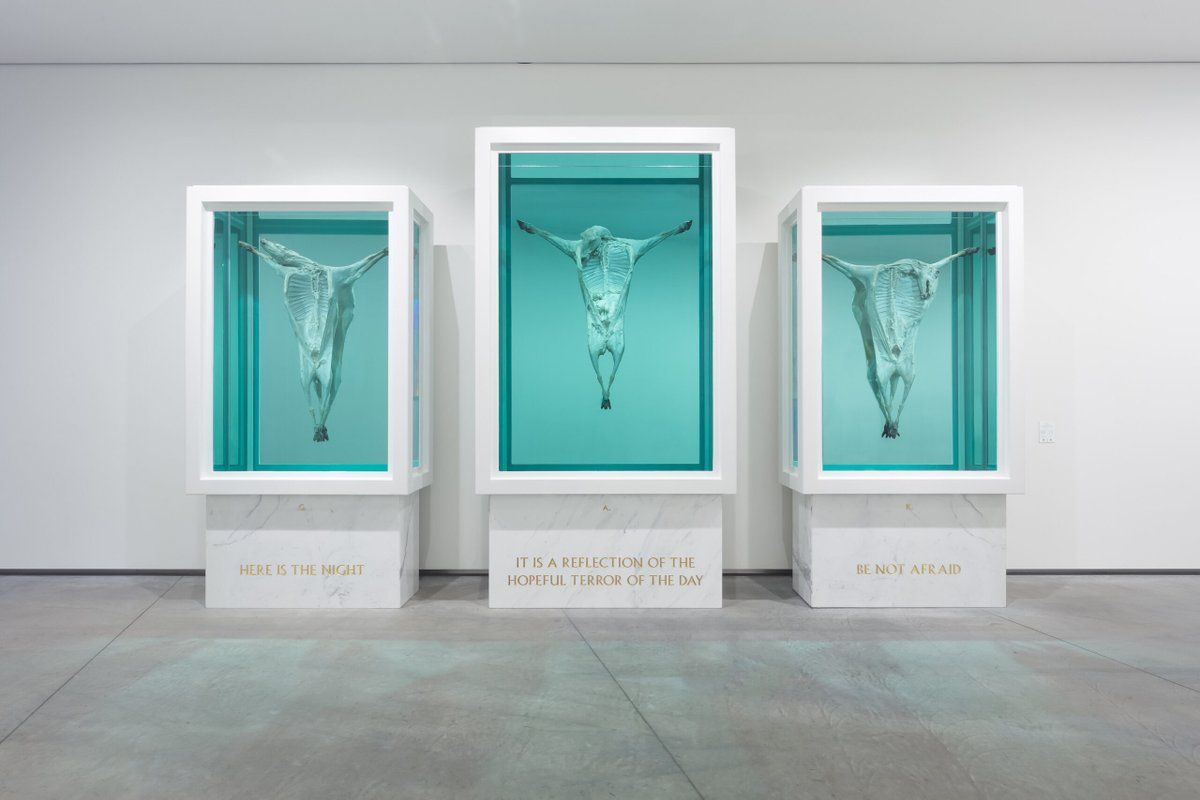
In this sense, the laboratory assumes a role once associated with the sacred.
Where earlier societies preserved religious relics in the hope of spiritual continuity, Hirst preserves biological remains through chemical intervention.
His installations reveal a modern tension between scientific confidence and existential uncertainty. Technology may extend the physical presence of a body, but it cannot restore the life that once animated it.
Beauty, Violence, and the Ethics of Looking
Hirst's work has consistently provoked debate over the relationship between artistic freedom and the ethical treatment of animals.
The use of real animal bodies raises difficult questions. Can death become an aesthetic object? Does the transformation of an animal into an artwork create understanding, or does it risk turning suffering into spectacle?
These questions are central to the experience of the work rather than incidental to it.
The carefully constructed installations are visually seductive. Their proportions, transparency, and controlled environments produce an almost architectural elegance. Yet this beauty exists alongside the undeniable reality of death.
The viewer's attraction to the work becomes inseparable from an awareness of its disturbing material.
Hirst does not allow beauty to remain innocent. Instead, he exposes the uncomfortable relationship between looking, knowing, and confronting what we might otherwise prefer to avoid.
Art at the Boundary of Existence
Damien Hirst's preserved animals are often remembered for their visual shock, but their lasting significance extends beyond provocation.
They reveal a persistent contradiction in the human condition: our desire to understand and control life exists alongside our inability to escape its inevitable end.
Through the language of science, the symbolism of religion, and the physical presence of death, Hirst transforms the exhibition space into an environment of existential reflection.
The shark, the divided cow, and the solitary lamb are not merely preserved bodies. They become images of human vulnerability, vessels of belief, and reminders of the fragile boundary between existence and disappearance.
In the stillness of these glass chambers, death is made visible, yet remains impossible to fully comprehend.
Perhaps the most unsettling aspect of Hirst's art is not that it shows us death, but that it reveals how little we understand about being alive.