Most artists create objects for people to look at. Olafur Eliasson creates experiences that make people reconsider how they look at the world in the first place.
Imagine entering a museum and suddenly finding yourself surrounded by artificial sunlight, thick fog, or a rainbow suspended in mid-air. Your first reaction might be confusion. Your second might be delight. By the third minute, you may begin to wonder whether you are still in a gallery or have accidentally stepped into a weather forecast simulation. This delicate balance between wonder and reflection lies at the heart of Eliasson’s artistic practice.
Olafur Eliasson was born in Copenhagen and grew up between Denmark and Iceland, a landscape that already feels like one of his installations: part rational design, part raw nature. He was shaped by the Scandinavian tradition of minimalism, but also by an almost poetic attention to glaciers, light, and atmospheric change. As a result, he does not appear to be someone who simply “makes art objects,” but rather someone who studies how the world behaves—except his laboratory happens to be the museum space.
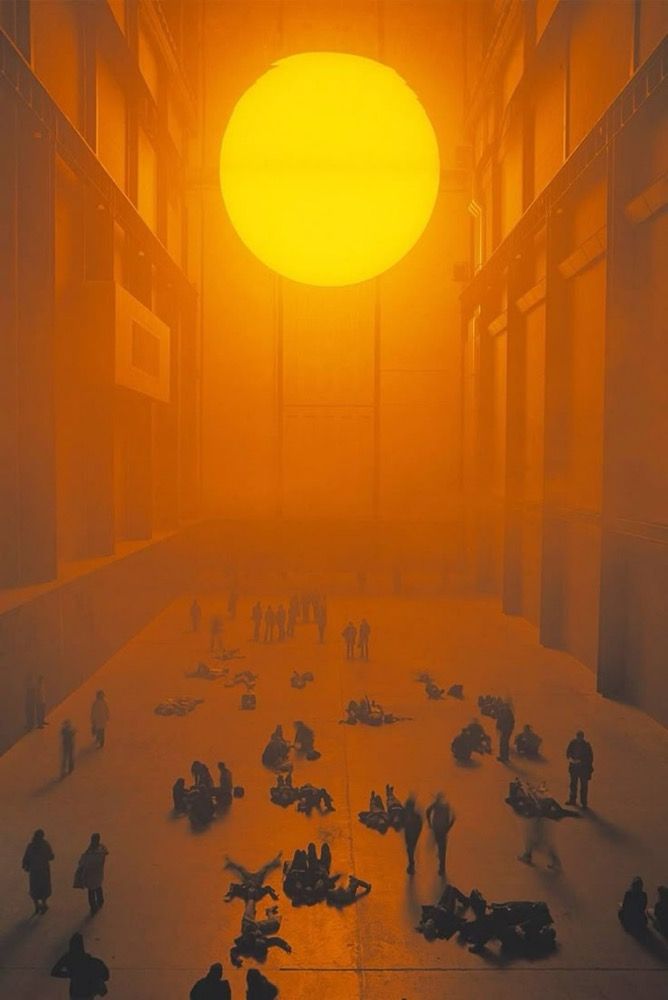 One of his most famous works, The Weather Project, transformed the Turbine Hall of Tate Modern into a vast indoor sun. Visitors gathered under its glowing orange light, many lying on the floor as if they were in a public park rather than one of the most prestigious museums in the world. It remains one of the rare occasions where staring directly at an artificial sun was not only permitted, but quietly encouraged.
What is equally striking is Eliasson’s own personal presence. He does not rely on dramatic self-promotion or a highly stylised public persona, as many contemporary artists do. Instead, he tends to appear as a calm facilitator—someone who gently invites audiences into altered ways of perceiving reality. One might imagine that if he had not become an artist, he could have been a meteorologist, except his weather reports would include feelings, reflections, and shifting light conditions.
More importantly, Eliasson maintains a careful and consistent resistance to the over-commercialisation of art. In a world where artworks are often treated as financial assets and auction records matter as much as aesthetic experience, he repeatedly emphasises process, perception, and participation over ownership. For him, the value of art lies not in possession, but in experience.
This is not a simple rejection of the art market in slogan form, but a practice embedded in how he works. His studio operates more like a collaborative laboratory than a production line for sellable objects. Artists, scientists, architects, and engineers often work together on projects that are designed to be experienced rather than collected. In this sense, the artwork is not something you own—it is something that happens to you.
This approach also reflects his personal charisma: a quiet refusal to centre himself as the “star” of his own work. Instead, he allows light, mist, water, and the audience to become the true protagonists. Paradoxically, this withdrawal from self-promotion only strengthens his presence. The less he insists on being seen, the more clearly his ideas are felt.
Eliasson’s appeal lies in this “quiet persuasion.” He does not overwhelm viewers with spectacle for its own sake. Instead, he constructs environments that slowly reveal how perception shifts over time. His works do not command you to look; they gently ask whether you have noticed how you are already looking.
Ultimately, Eliasson challenges one of our most basic assumptions: that seeing is a passive act. Through immersive installations and carefully constructed environments, he demonstrates that perception is active, personal, and constantly changing. His art invites us to slow down, reconsider, and rediscover the extraordinary conditions hidden within everyday experience.
In a cultural moment where art and consumption are often blurred, his work and his attitude offer a rare alternative: art does not need to be owned in order to matter. It only needs to be experienced. And perhaps, in the end, what matters most is not what you acquire—but what you actually learn to see.